Guide
Commercial Fryer Troubleshooting: Symptom-First Checks
Commercial fryer troubleshooting for gas and electric units: what staff can safely check when a fryer won't light, heat or hold temperature, and when to call.
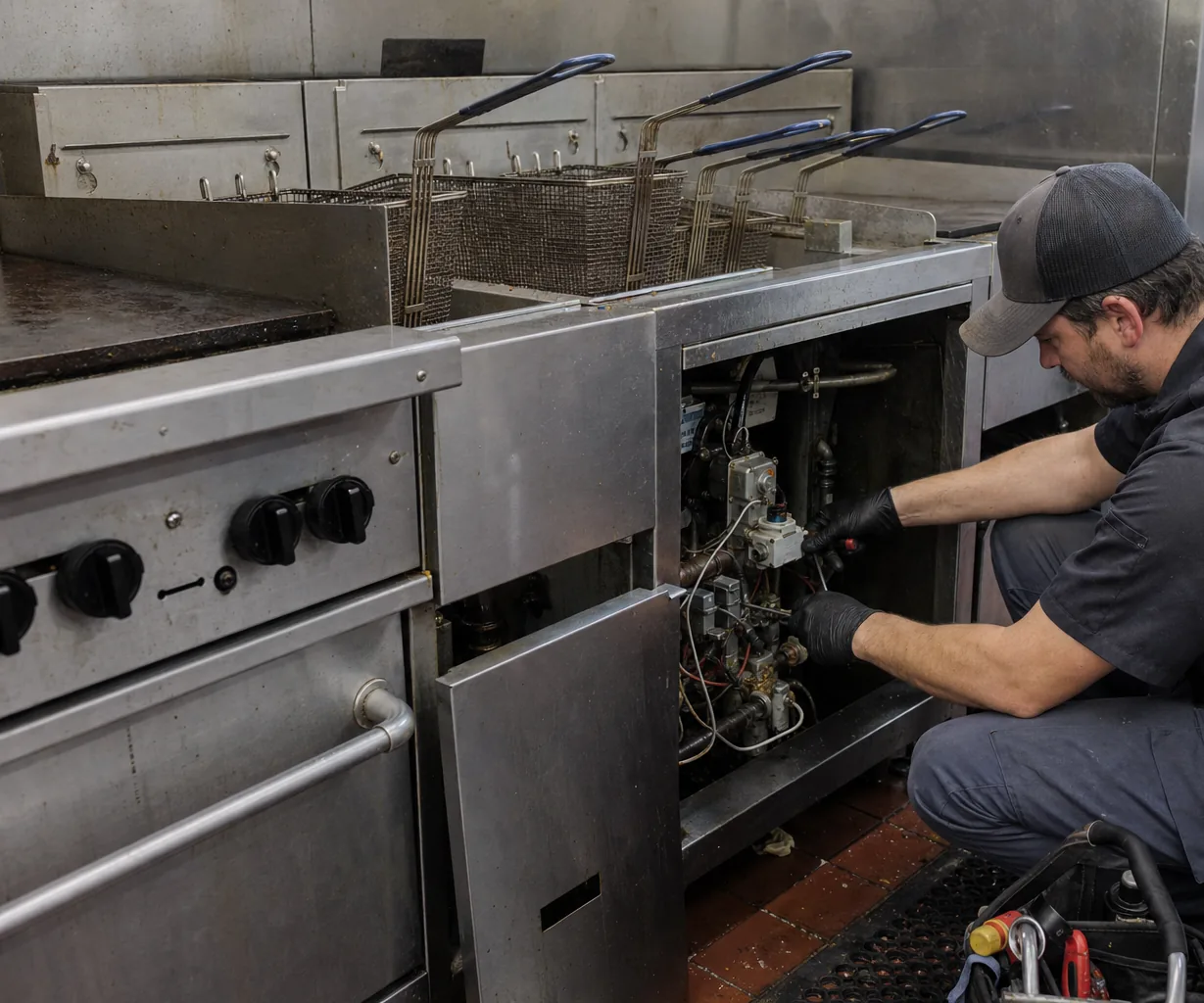
Commercial fryer troubleshooting works best in 3 steps: confirm the gas or power supply, check the reset (high-limit) switch, then compare the oil temperature with a separate thermometer before you blame a part. Most failures show up in that order, and staff can run all 3 checks without opening the cabinet or touching a gas fitting.
If you smell gas, skip the checks: shut the fryer’s gas valve, keep flames away, ventilate and call the gas utility before anyone relights.
What fails first on a commercial fryer?
Fryers fail along the path the heat takes. A gas unit needs gas at the valve, a lit pilot and a part that proves the flame. An electric unit needs power, a closed high-limit circuit and working elements. Then comes the thermostat. That order stops you replacing a thermostat when the hose was simply left unseated after cleaning.
Why won’t a gas fryer light or stay lit?
Check that the shutoff behind the fryer is fully open and the quick-disconnect clicked home. Then follow the lighting steps in the manual exactly, including how long to hold the gas knob. If the pilot drops out when you release the knob, suspect the thermocouple or thermopile, or a blocked pilot orifice. Grease on a cool pilot can be brushed off; the gas valve is technician work.
Why does an electric fryer trip or heat slowly?
Check the breaker, then the fryer’s reset button, usually under or behind the control panel. One trip after running low on oil is a warning; repeated trips with a full vat point to a thermostat or contactor fault. Slow heating often means one element has failed. Never power uncovered elements.
How long should a commercial fryer take to heat up?
A healthy fryer usually reaches 350°F in roughly 10 to 15 minutes from cold, longer with a melt cycle. Burners are sized to the oil load: Vulcan rates its LG300 at 90,000 BTU/hr for 35-40 lbs of shortening, the LG400 at 120,000 BTU/hr for 45-50 lbs and the LG500 at 150,000 BTU/hr for 65-70 lbs. If recovery is slower than last month, note the time for the technician.
| Symptom | Likely cause | What staff can check | When to call a technician |
|---|---|---|---|
| Pilot won’t light | Closed valve, loose hose, blocked orifice | Valves open, hose seated | Fails after one correct attempt |
| Pilot goes out | Weak thermocouple or thermopile | Clean the cool pilot, relight once | It drops out again |
| Shuts off mid-service | High-limit tripped, low oil | Top up, cool, press reset | Trips again with a full vat |
| Oil smokes or runs hot | Thermostat out of calibration | Check with a separate thermometer | Readings disagree twice |
| Slow recovery | Failed element or burner | Time the warm-up | Slow for two shifts |
| Oil under the fryer | Drain valve or tank leak | Close the drain valve, wipe | Any tank leak, right away |
Is the oil safe to cook with while you wait?
Not if the temperature is wrong. A fryer that overshoots breaks oil down and raises fire risk; one that runs cool turns out greasy, undercooked product. Take that vat out of service, move items to a second vat or pull them from the menu, and log what you saw. On a new unit, check the paperwork first: Garland covers adjustments and calibrations only for the first ninety (90) days after installation.
Which habits prevent most fryer calls?
Vulcan’s LG manual calls for filtering shortening at least once a day while it is between 250°F and 350°F, and warns against solid shortening in the LG300 or LG400, because melting it damages the tank and voids the warranty. For the weekly boil-out, fill between MIN and MAX with low-foaming cleaner, simmer 15 to 20 minutes without passing 200°F, drain, neutralize with 1 cup of vinegar in fresh water, rinse and dry. A tank verified leaking in year one gets the whole fryer replaced; later leaks get partial coverage, and after 5 years there is none.
Near Garden State Plaza or Route 17, if Sunday traffic dips while Paramus blue laws close most stores, use that shift for the boil-out.
When should you call a technician?
Call when a check fails twice, or at once for gas smell, a leaking tank or repeated tripping. Paramus Commercial Appliance Repair is an independent service, not manufacturer-authorized, covering Paramus, Hackensack, Ridgewood, Fair Lawn and nearby towns. Typical ranges are $95–$165 for the service call, credited toward the repair, and $200–$800 for commercial fryer repair; the firm quote is given on site after diagnosis. See repair pricing or call (914) 350-6776.
Frequently asked questions
How do you start a commercial fryer?
Fill the vat to the oil line, then follow the start-up steps on the fryer’s label or manual. On gas units, open the gas, light the pilot and hold the knob for the stated time before setting the thermostat.
How do you reset a fryer’s reset button?
Let the oil cool, confirm the level, then press the high-limit reset under or behind the control panel. If it trips again with a full vat, stop and call for service.
How long does it take a commercial fryer to warm up?
Typically 10 to 15 minutes to reach 350°F from cold. A warm-up that keeps getting slower points to a burner, element or gas-supply problem.